

The starter motor, also known as the starter motor, is the core component of the internal combustion engine starting system. Its function is to convert electrical energy or other forms of energy into mechanical torque, drive the engine crankshaft to rotate, and complete the engine start-up. According to the structural form, operation mode, gear meshing form, magnetic field type, and power source, starters can be divided into multiple types, and different types of starters have significant differences in structural principles, performance characteristics, and applicable scenarios.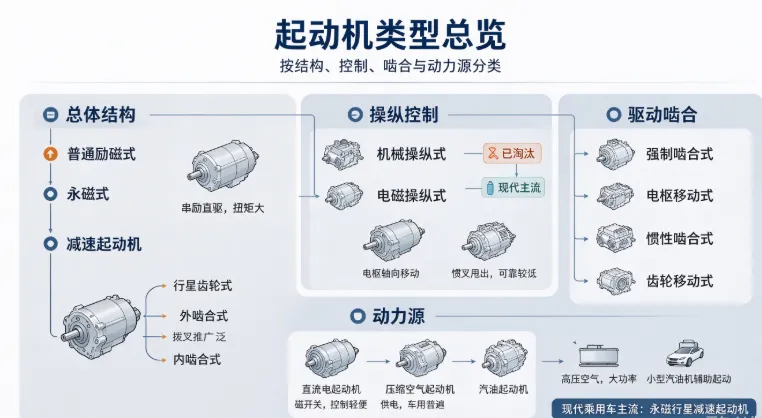
1、 Classified by overall structure
1. Ordinary series excited starter motor
The ordinary excitation starter belongs to the direct drive structure, with the stator using excitation winding and the motor being a series excited DC motor. The armature shaft is directly connected to the driving gear, and there is no reduction mechanism in between. The characteristics of a series excited motor are a large output torque at the moment of starting, strong impact resistance, mature technology, and simple maintenance. The disadvantage is that it has a large volume, heavy weight, and poor high-speed performance under the same power. This type of starter is more common in old trucks and early construction machinery, and is currently rarely used in passenger cars.
2. Permanent magnet starter motor
The permanent magnet starter uses a permanent magnet as the stator magnetic field, eliminates the excitation winding, and has a more streamlined structure. Compared to the excitation starter, it is smaller in size, lighter in weight, consumes less energy during operation, and generates less heat. However, permanent magnet materials are not resistant to high temperatures and severe vibrations, and are prone to demagnetization under high-power conditions. They have a lower power limit and are mostly used in small displacement household passenger cars.
3. Deceleration starter motor
The deceleration starter adds a deceleration gear mechanism between the armature and the driving gear, relying on the high-speed operation of the motor. Through the gear set, the speed is reduced and the torque is increased. Under the same output power, the volume can be reduced by about 30% compared to ordinary starters. According to the gear structure, deceleration starters are divided into three types: planetary gear type, external meshing type, and internal meshing type. Planetary gear type is currently the mainstream, with the armature and drive gear arranged coaxially, compact structure, smooth transmission, and low noise; The external meshing type is parallel axis gear transmission, which is easy to disassemble and assemble, but the overall length of the machine is relatively large; Internal meshing transmission has high efficiency, but its structure is complex and the manufacturing cost is higher. Modern new cars are widely usedPermanent magnet deceleration starterIntegrating the dual advantages of permanent magnet motors and planetary gearboxes.
2、 Classified by manipulation control method
1. Mechanically operated starter motor
Mechanical control relies on mechanical mechanisms such as foot pedals and pull rods to directly push the fork and connect to the main power supply circuit. The principle is simple and does not require electromagnetic control components, but it requires the installation of a long mechanical pull rod, which is laborious to operate. The main circuit contacts are prone to erosion and cannot be controlled remotely. This type has been largely phased out and can only be seen on antique vehicles and old tractors.
2. Electromagnetic controlled starter motor
Electromagnetic control is a standard feature of modern vehicles. The ignition switch or start button only delivers a small current to control the electromagnetic switch. The electromagnetic suction pulls the fork, synchronously completing the two actions of driving the gear to mesh with the flywheel ring gear and connecting the starter main circuit. This method only requires a small current to complete control, with flexible layout of control switches, easy operation, and reliable performance. It is widely used in various types of automobiles and light diesel equipment.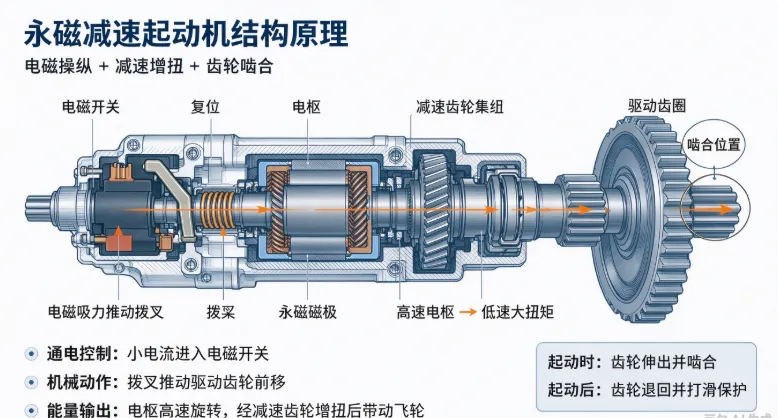
3、 Classified by the meshing method of the driving gear
1. Forced meshing type
Forced meshing relies on an electromagnetic switch to pull the fork and forcefully push the driving gear towards the flywheel ring gear. If the tooth tips are pressed against each other, the buffer spring will compress, the motor will rotate slightly, and the meshing will be completed after the tooth positions are aligned. The structure is simple and reliable, but the disadvantage is that the meshing impact is large, and the gear wear is relatively faster. It is the most commonly used form for passenger cars and light trucks.
2. Armature mobile type
The armature moving type relies on electromagnetic attraction to drive the entire armature to move axially, thereby achieving meshing between the driving gear and the flywheel without the need for a fork. It can withstand a large starting torque and is suitable for high-power diesel engines; But the armature needs to slide axially, the commutator wears out quickly, and the overall volume is large, which is more common in early heavy-duty diesel vehicles.
3. Inertial meshing type
The inertia meshing drive gear is fitted onto the helical spline of the armature shaft. When the armature rotates, it relies on its own rotational inertia to allow the gear to slide forward along the helical spline and mesh with the flywheel. The structure is the simplest, without a fork component, but the meshing reliability is poor. It is prone to meshing failure at low temperatures and high engine resistance, and the engine may not detach in time after catching fire, which can easily damage the gears. It has been basically eliminated.
4. Gear mobile type
Gear mobile type is commonly used for planetary reduction starter motors, where electromagnetic switches directly drive the gear components without the armature itself moving. The meshing process is relatively smooth, with less impact and higher requirements for electromagnetic switch thrust.
4、 Classification by motor magnetic field type
The starter motor is divided into series excitation, parallel excitation, compound excitation, and permanent magnet type.Series excitation typeThe excitation winding is connected in series with the armature, and the low-speed torque is extremely strong. The speed changes rapidly with the load, making it the mainstream of traditional fuel vehicle starters. The disadvantage is that it prohibits high-speed operation without load and is prone to damage due to runaway. The parallel excitation winding and armature have good speed stability, but the starting torque is insufficient and rarely used for engine starting. The compound excitation type has both series excitation winding and parallel excitation winding, balancing torque and speed stability, and is rarely used in starter motors. The permanent magnet type has been introduced earlier, relying on permanent magnets to establish a magnetic field without excitation coils.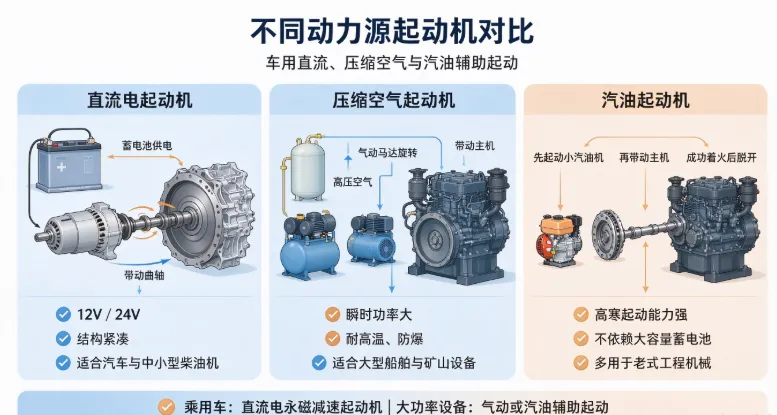
5、 Classified by power source
1. DC starter motor
DC starter motor relies on battery power supply, which is a common starting motor in cars, divided into two voltage levels of 12V and 24V. The 12V version is mostly used for gasoline engine passenger cars; The 24V version is used for trucks, buses, and medium to large diesel engines. High voltage can reduce operating current and minimize line losses.
2. Compressed air starter motor
The compressed air starter relies on high-pressure compressed air to drive the pneumatic motor, which drives the crankshaft of the main engine to rotate. Instantaneous output power is enormous, with the characteristics of explosion-proof and high temperature and humidity resistance. The disadvantage is that the entire system requires a matching air compressor and storage tank, and the equipment volume is large. Mostly used for large ships, high-power generator sets, and heavy-duty diesel engines in mines.
3. Gasoline starter motor
The gasoline starter belongs to the auxiliary starting device, and the main engine is a large diesel engine equipped with a small gasoline engine as the starting power. When working, start the small gasoline engine first, and then drive the main engine to run. After the main engine successfully catches fire, it will automatically disconnect. The advantage is strong starting ability in cold and high-altitude environments, and there is no problem of battery depletion; The disadvantage is that the structure is complex and requires an independent fuel supply system, which is mostly used for old large bulldozers and other construction machinery.
Conclusion
With the continuous development of automotive technology, starter motors continue to iterate towards miniaturization, lightweighting, and high efficiency. Traditional direct drive excitation starters are gradually withdrawing from the passenger car market,Permanent magnet planetary deceleration electromagnetic control forced meshing starterBecoming the mainstream solution for current fuel vehicles. In the field of high-power equipment such as ships and mining machinery, pneumatic starters or auxiliary gasoline starters are selected according to the working conditions. Understanding the structure, principles, and applicable scenarios of various types of starters is helpful for the maintenance, selection, and fault analysis of starter systems.