

Commercial vehicles, construction machinery, and internal combustion forklifts commonly use an AC generator driven by an engine belt to supply power to the vehicle's electrical equipment and charge the battery. The operating environment of such equipment varies greatly: trucks often travel on highways and are susceptible to corrosion from rainwater and mud water; Construction machinery has been working on construction sites with high levels of dust and vibration for a long time; The installation position of the internal combustion forklift is too low, which makes it easy to splash mud and water and be bumped by goods. Adverse working conditions can accelerate the aging of the generator. Standardized maintenance and accurate fault diagnosis can reduce problems such as downtime, battery damage, and electrical burnout. This article only applies to internal combustion engine models with accompanying generators. Electric forklifts do not have engine driven generators and are not applicable to the content of this article.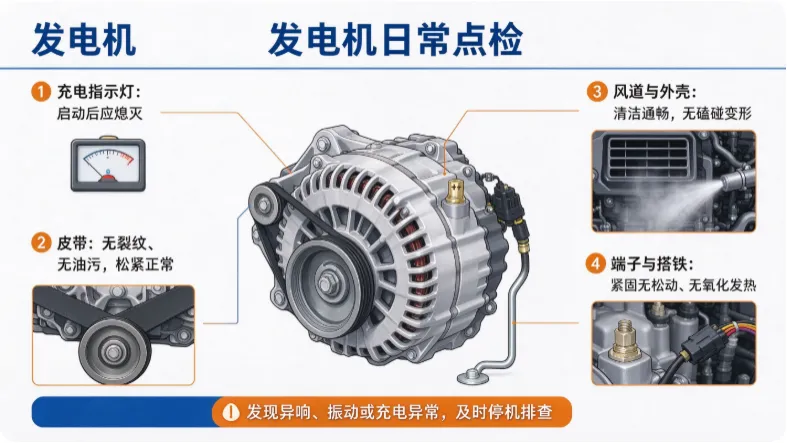
1、 Specific content of daily maintenance
Daily maintenance is mainly based on pre - and post shift inspections, completed by machine operators and workers, with a focus on early detection of abnormalities and avoiding prolonged work with faults. All inspections should be carried out with the engine turned off as much as possible, and it is strictly prohibited to directly flush the generator body with water when using the heat engine.
Before starting the homework, first observe the charging indicator light. Turn on the key and power on, the indicator light should light up normally; The indicator light goes out after starting the engine. If the indicator light stays on and flashes continuously after startup, it indicates that the charging system is abnormal and it is not recommended to overload the operation for a long time; If the indicator light does not light up after power on, it is necessary to check the fuse, indicator light circuit, and excitation circuit.
Next, check the drive belt and tensioning components. Visually inspect the belt for cracks, missing teeth, hardening, fuzzy edges, oil or hydraulic oil stains. Oil stained belts are prone to slipping and rapid aging, and need to be cleaned or replaced in a timely manner. The tightness of the belt can be pressed at the middle position of the belt span, with a conventional deflection of 10-12mm. The final result shall be subject to the original equipment manual; Loose belts can cause slipping and insufficient power generation, while tight belts can exacerbate bearing wear. Simultaneously observe whether the tensioning wheel is stuck or loose.
Then check the appearance of the generator and the cooling air duct. Clean the dust, dirt, and coal powder accumulated on the outer shell and air inlet and outlet. Blockage of the air duct can cause poor heat dissipation of the generator and burn out the windings at high temperatures; Check for any bumps, cracks, or deformations on the outer shell, and pay close attention to the traces of mud and water soaking at the bottom of the forklift.
Wiring terminals, plugs, and grounding points are also mandatory items to be checked. Check if the B+main output terminal, excitation plug, and grounding wire fixing screws are loose or oxidized to white; Is the wiring harness worn out by oil pipes, brackets, and frames, and is the dust cover of the plug missing. Poor grounding is a common cause of unstable charging and flashing indicator lights, and both the engine and body grounding wires need to be checked synchronously.
Listen for abnormal noise during idle operation. The generator operates normally with only uniform wind noise; If there is a rustling sound, buzzing sound, metal friction noise, or obvious vibration of the casing, it is highly likely that the bearings are worn. You can gently shake the pulley to check for radial clearance.
Finally, synchronously check the battery pile head for looseness, oxidation, and leakage. Battery depletion and single cell damage will continue to increase the load on the generator and accelerate its damage.
After the homework is completed and the machine is stopped, observe whether there is any abnormal burning or burnt smell on the generator casing; Use a brush and low-pressure air to clean the floating dust and dirt on the ventilation opening, and prohibit high-pressure water guns from directly hitting the generator and plug; Extra inspection of the forklift's wiring harness to ensure it is not damaged or scratched by shovel teeth or cargo. When the equipment is parked for a long time, simplify the inspection items and focus on monitoring the battery depletion and whether the wiring is loose.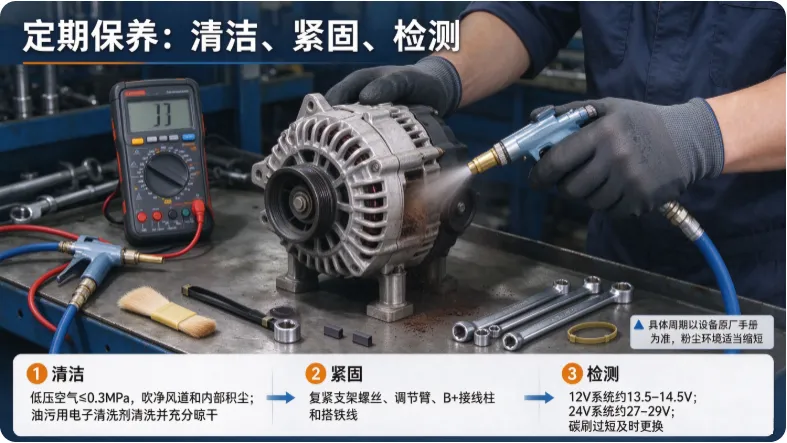
2、 Regular maintenance content
Regular maintenance is carried out by maintenance personnel, and the maintenance cycle is adjusted according to the environment. For mining and construction sites with high dust and strong vibration, the cycle is halved. Under normal operating conditions, cleaning should be carried out within 200-300 hours, fasteners should be tightened within 300 hours, and electrical testing should be carried out within 500 hours.
When cleaning, use a soft bristled brush and low-pressure compressed air adjusted to within 0.3MPa to blow away internal carbon powder and dust from the air outlet; For areas with heavy oil stains, use electronic insulation cleaning agents to clean them, let them dry thoroughly before installation, and do not rinse directly.
Tighten the fixing bracket, adjusting arm, and grounding screws of the generator. Due to the high vibration of construction machinery, loose screws can easily cause rotor and stator sweeping.
Electrical testing relies on a multimeter to measure the charging voltage. The standard idle charging voltage for 12V systems is 13.5-14.5V, and for 24V systems it is 27.0-29.0V. For brushed generators, remove the rear cover and check the remaining length of the carbon brush. Generally, if the remaining length is less than 3-5mm, replace it directly; The slip ring has slight erosion and grooves, which can be repaired by polishing with 00 # fine sandpaper; Brushless generators do not require replacement of carbon brushes. The bearings have looseness and abnormal noise. It is recommended to replace them directly to prevent them from locking and sweeping the bore.
3、 Tools and consumables required for maintenance
According to the usage scenario, it is divided into three categories: daily inspection, regular testing, and disassembly and maintenance, with supporting safety protection equipment.
Daily inspection tools: LED flashlight, protective gloves, wiping cloth, optional feeler gauge, marker pen, used to observe concealed positions and mark screw positions.
Regular maintenance and testing tools: digital multimeter (supporting DC voltage, buzzing, diode mode), low-voltage pressure regulating air gun, soft bristle brush, socket, opening, and ring wrench set; Optional torque wrench and belt tension meter for precise tightening and belt tension detection.
Disassembly and maintenance tools: Phillips and Phillips screwdrivers, internal and external spring pliers, two or three jaw pullers, copper rods, bearing press fit sleeves, 00 # fine sandpaper, pointed nose pliers, diagonal pliers, insulation tape, heat shrink tubing.
Common auxiliary materials and consumables: conductive anti oxidation grease, zip ties, spare carbon brushes and brush holders, plug dust covers, electronic cleaning agents.
Safety protective equipment: goggles, insulated gloves, maintenance warning signs, flameout locks, eye protection during dust blowing, and insulation protection for electrical measurements.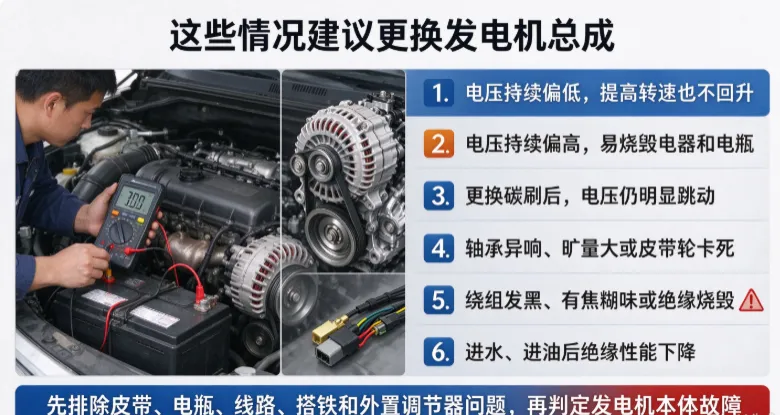
4、 Method for determining whether the generator needs to be replaced
Before making a judgment, it is necessary to first eliminate peripheral faults. Many charging abnormalities are only caused by belt, battery, circuit, grounding, and external regulator faults, not by damage to the generator body. Do not replace the assembly directly.
Partial faults can be repaired without the need to replace the assembly: only the carbon brush is worn and the carbon brush holder is damaged; Slight erosion of the slip ring; External independent regulator damaged; The shell is slightly bumped, and the winding has no short circuit or burn marks.
If any of the following conditions are met, it is recommended to replace the generator assembly directly. Construction machinery and forklifts have limited disassembly and assembly space, resulting in lower assembly replacement time and better stability.
Abnormal voltage detection: After ruling out belt slippage, virtual connection of the circuit, and damage to the battery, the charging voltage remains below the lower limit of the standard, and the speed cannot be increased to recover; The voltage continues to exceed the standard, and the built-in regulator fails, which can easily burn out the battery, lighting fixtures, and instruments; After replacing the carbon brush and handling the plug, the voltage still fluctuates violently, mostly due to virtual welding and internal disconnection of the winding.
Mechanical failure: abnormal noise from bearings, large radial displacement of pulleys; Friction between rotor and stator, resulting in scratches and iron powder on the sweeping chamber; The pulley is stuck and the bearing is locked.
Burning and insulation damage: There is a burnt smell, blackened windings, and insulation melting and bulging; Rectifying diode breakdown, circuit board burnout; The shell cracks, water and oil enter, and the insulation of the winding breaks down. Generators with water ingress, hydraulic oil, and engine oil, even if temporarily capable of generating electricity, will experience a rapid decrease in insulation performance, and it is not recommended to repair them under vibration conditions.
Static detection of multimeter: disconnect the negative terminal of the battery when the engine is turned off, and ensure that the winding is connected to the generator casing (with the winding grounded); The rotor slip ring is conductive to the outer shell; The rectifier bridge pins conduct in both directions, causing diode breakdown.
5、 Maintenance operation taboos
During maintenance and use, there are several types of operations that can easily damage the generator and need to be strictly prohibited. It is prohibited to use a screwdriver to directly connect the B+terminal and the shell for "scraping" power generation, as it may instantly break down the rectifier diode; When the engine is running, it is forbidden to disconnect the main battery line to test the generator; When cleaning the entire machine, the high-pressure water gun should not directly hit the generator body and plug; Do not continue to use the belt if it is contaminated with oil; After the charging fault light is on, do not work with the fault for a long time; It is strictly prohibited to connect the positive and negative poles in reverse, as it may directly burn the rectifier bridge.
6、 Different equipment maintenance focuses
Commercial vehicles should focus on preventing rainwater and mud from corroding plugs, pay attention to wire harness wear, and check the charging indicator light every time the vehicle is driven; There is a lot of dust and severe vibration in construction machinery, and the cleaning cycle should be shortened. The focus should be on checking the fastening of brackets, bearings, and heat dissipation ducts; The installation position of the internal combustion forklift is low, with a focus on preventing mud and water intrusion, preventing shovel teeth, and preventing cargo from colliding with the wiring harness.
Conclusion
The generator is the core component of the vehicle charging system, and many of its faults are caused by long-term neglect of small hidden dangers. Adhere to daily inspections and regular maintenance according to working conditions, accurately distinguish between line faults and generator body damage, and choose maintenance or assembly replacement reasonably. This can not only reduce equipment downtime losses, but also extend the service life of generators, batteries, and vehicle electrical appliances. All maintenance and repair operations should prioritize following the requirements of the original equipment maintenance manual.