

The power core of commercial vehicles, construction machinery, and internal combustion forklifts is mostly large displacement diesel engines. These engines have high compression ratios and high starting resistance, and the equipment operates under harsh conditions such as heavy loads, dust, vibration, and low temperatures for a long time, making it impossible to start on its own. The dedicated industrial starter is the core component of the starting system for such equipment. Its core function is to convert the electrical energy of the battery into high torque mechanical energy, drive the engine flywheel and crankshaft to rotate for a short period of time, assist the engine in completing the intake and compression strokes, and achieve ignition self ignition and autonomous operation. After the equipment is started, the starter immediately exits work and operates in a short-term high-power mode throughout the process, without participating in the normal operation of the equipment. Compared to ordinary passenger car starters, commercial vehicles, construction machinery, and forklift starters have higher structural strength, greater starting torque, and stronger environmental adaptability. They are mainly divided into two categories: DC series excitation direct drive and deceleration. The overall structure still consists of three core components: DC motor, electromagnetic switch, and transmission mechanism. Each component works in precise timing coordination to ensure stable starting under harsh working conditions.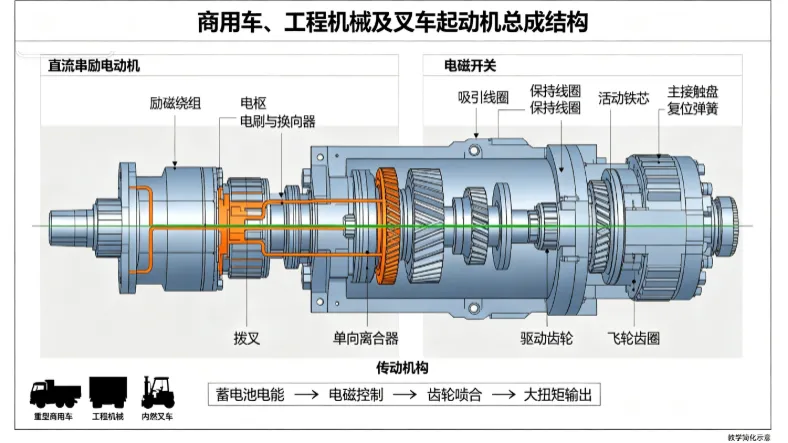
DC motor is the power output core of industrial equipment starter, suitable for the high resistance starting requirements of diesel engines, and the mainstream is24V DC series excited structureSome models of small forklifts adopt a 12V specification, with a power coverage of 3-10kW, which is much higher than that of passenger car starters. The motor is mainly composed of excitation winding, armature, high-strength electric brush, and commutator. The structural characteristics of the armature winding and excitation winding in series make it have significant low-speed and high torque advantages, which can perfectly adapt to the huge starting load brought by the high compression ratio of diesel engines. Some large construction machinery starters are equipped with reduction gear mechanisms, which further enhance the starting power by reducing speed and increasing torque, meeting the starting needs of large displacement diesel engines such as excavators, loaders, and heavy-duty trucks. At the same time, the motor has been reinforced for dust prevention, earthquake resistance, and high temperature resistance, making it suitable for complex working environments such as construction sites, mining areas, and warehouses.
The electromagnetic switch is the control core of the starter motor, which is a key component for achieving low current control and high current, mechanical meshing linkage. Its structure is adapted to the high-power working characteristics of industrial equipment, and it includes an attraction coil, a holding coil, a thickened movable iron core, a large capacity main contact plate, and a high-strength reset spring. Compared to passenger car electromagnetic switches, its contact current carrying capacity is stronger, and it can withstand a super large working current of 200-600A at the moment of starting. After the attraction coil is energized, it can pull the iron core forward, and at the same time, it can divert the current to drive the motor to low-speed pre rotation, avoiding gear hard impact; Keep the coil continuously stabilizing and attracting the iron core to ensure that the gears do not disengage and the circuit is not interrupted during the start-up process; The large capacity main contact plate is responsible for connecting the high current circuit between the battery and the motor; The reset spring provides stable mechanical power for the component to return to its original position, ensuring precise reset during each start-up cycle.
The transmission mechanism consists of a reinforced shift fork, a heavy-duty one-way clutch, and a high-strength drive gear, which is the core structure of power transmission and equipment protection. It is specially optimized for high-frequency starting and strong vibration working conditions of industrial equipment. The fork is made of thickened wear-resistant material, which has stronger rigidity and can stably transmit the thrust of the iron core; The driving gear module is larger, the tooth surface is hardened, wear-resistant and impact resistant, and can reliably mesh with the flywheel ring gear of heavy-duty diesel engines; The one-way clutch is the core protective component and adopts a roller type heavy-duty structure. It only allows the starter to transmit power unidirectionally to the engine flywheel, completely eliminating the situation of high-speed reverse dragging of the starter after the engine starts, effectively avoiding damage to the motor rotor and gears, and adapting to the high-intensity operation requirements of construction machinery and commercial vehicles.
The workflow logic of commercial vehicles, construction machinery, and forklift starters is unified, and each component strictly works in coordination with the three timing stages of engagement, drive, and reset protection. The entire process is automated and closed-loop, and is adapted to the start-up operation specifications of various industrial equipment.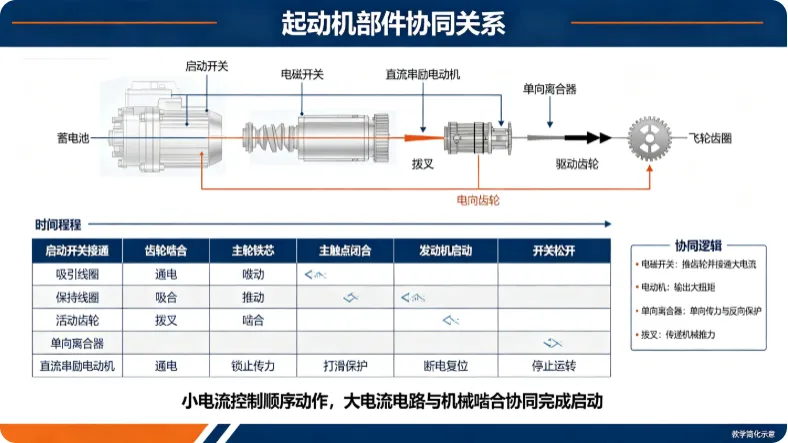
The first stage is the smooth meshing of gears. After the operator turns the start key or presses the start button, the battery outputs a small current to control the suction coil and holding coil of the electromagnetic switch. The two sets of coils generate electromagnetic attraction in the same direction, and the suction attachment moves the thick movable iron core forward. During the forward movement of the iron core, on the one hand, it drives the high-strength shift fork to complete the lever rotation, driving the one-way clutch and the driving gear to move axially forward as a whole, gradually fitting and meshing with the heavy-duty flywheel ring gear of the engine; On the other hand, the shunt current that attracts the coil is passed into the DC motor, driving the motor to rotate slightly at low speed, eliminating the rigid resistance of gear meshing, avoiding gear breakage and tooth breakage faults, achieving smooth meshing, and adapting to equipment refrigeration and heavy-duty starting conditions.
The second stage is the high torque power drive stage. When the driving gear is fully engaged with the flywheel ring gear, the movable iron core reaches its limit stroke, and the rear high-capacity main contact plate closes, connecting the high current working circuit between the battery and the DC motor. The battery's ultra-high current continuously flows into the electric motor, and the series excited motor outputs stable high torque. The power is transmitted to the heavy-duty one-way clutch through the armature shaft. At this time, the one-way clutch is locked and stuck, and the power is transmitted to the driving gear without loss, driving the engine flywheel and crankshaft to rotate at high speed, forcing the diesel engine to complete the intake and compression strokes. After reaching the compression ignition condition, it ignites and does work, and the engine enters the autonomous operation state. At this stage, the attraction coil stops working due to the potential difference at both ends returning to zero. Only the coil is maintained independently to maintain the iron core attraction state, stabilize the meshing structure and high current circuit, and ensure uninterrupted starting process.
The third stage is component reset and safety protection. After the engine is successfully started and the equipment enters idle operation, the operator releases the start switch, and the two sets of coils of the electromagnetic switch are synchronously cut off, and the electromagnetic suction force completely disappears. The movable iron core quickly resets backwards under the elastic force of the high-strength reset spring, driving the fork to rotate and pulling the driving gear and one-way clutch backwards, completely separating the gear from the flywheel ring gear. At the same time, the main contact plate disconnects the high current circuit, causing the DC motor to instantly shut down and stop running, and the starter completes a single start cycle.
The one-way clutch at this stage plays a critical safety protection role: after the diesel engine is started, the flywheel speed will sharply increase, far exceeding the working speed of the starter. Even if the gears are not separated in time due to mechanical lag, the heavy-duty one-way clutch will automatically slip and spin, completely cutting off the high-speed power transmitted by the flywheel in the opposite direction, and avoiding faults such as starter motor burnout and gear fracture from the root, greatly improving the service life and adaptability of industrial starters to working conditions.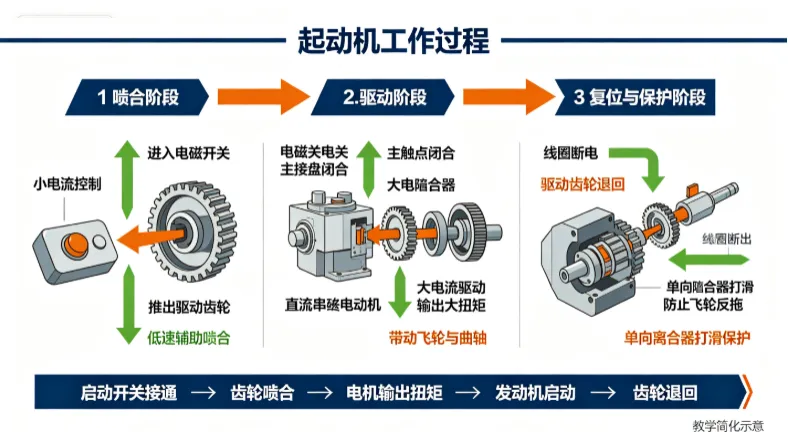
Overall, commercial vehicles, construction machinery, and forklift specific starters are high-power starting devices suitable for heavy-duty diesel engines and harsh working conditions. Electromagnetic switches accurately achieve synchronous linkage between circuit control and mechanical meshing, reinforced DC motors provide sufficient starting torque, and the transmission mechanism is strengthened to complete power transmission and overload protection. The three components work in a highly coordinated and closed-loop manner, and can stably cope with complex working conditions such as low-temperature starting, high-frequency starting and stopping, strong vibration, and high dust. It is the core guarantee for stable starting of various industrial transportation, engineering operations, and warehousing and handling equipment.