

Automatic start stop is a mainstream energy-saving configuration in modern passenger cars, with the core function of automatically turning off the engine when the vehicle is stationary and idling, and quickly restarting the engine when starting, reducing idle fuel consumption and exhaust emissions. This system is different from the starting and power generation structure of traditional fuel vehicles, and has undergone special upgrades to the starter and generator. Currently, it is mainly divided into12V split start stop system和48V mild hybrid BSG/ISG integrated start stop systemTwo categories. The component structures, working principles, and fault characteristics of the two types of systems differ significantly. This article will comprehensively integrate relevant core knowledge and systematically explain their working logic and common fault problems.
1、 12V split start stop system (mainstream for household cars)
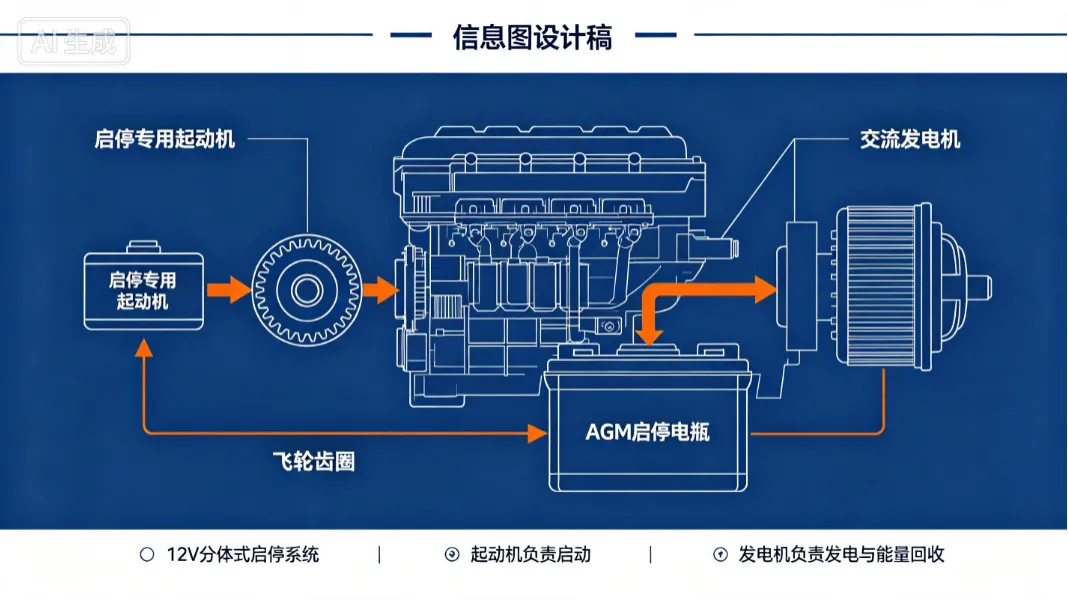
The vast majority of ordinary fuel powered household cars are equipped with a 12V automatic start stop system, usingEnhanced independent starter+dedicated AC generatorThe split structure of the AGM/EFB supports high-frequency start stop work, with two components each performing their own duties and cooperating with each other, which cannot be replaced universally.
(1) Working principle of start stop dedicated starter motor
Traditional ordinary starters are only used for the first ignition of vehicles when they are cold, and their operating frequency is extremely low. However, the start stop version starter needs to cope with high-frequency hot starts on traffic lights and congested roads, with a daily operating frequency of dozens of times. Therefore, the structure has been specially strengthened.
To adapt to high-frequency working scenarios, this starter motor has strengthened the structure of gears, bearings, and electromagnetic switches, with a much longer service life than ordinary starters, and can withstand hundreds of thousands of starting impacts.
(2) Working principle of 12V generator
In a 12V split system, the generator does not participate in engine start-up work and is only responsible for power generation, supply, and energy recovery. It is the core power guarantee for the stable operation of the start stop system. When the engine is running, the crankshaft drives the rotor of the generator to rotate, generating alternating current through electromagnetic induction, which is converted into direct current through an internal rectifier. On the one hand, it provides real-time power to the entire vehicle's electrical equipment, and on the other hand, it supplements the power of the AGM/EFB start stop battery.
In addition, the generator has a dedicated braking energy recovery function. When the vehicle is coasting or braking, the onboard computer will increase the excitation current of the generator to increase the power generation, converting the kinetic energy of the vehicle into electrical energy and storing it in the battery. This not only reduces energy consumption but also ensures the power reserve of the start stop system. It should be noted that during the gap between engine shutdown and start stop, the generator stops running, and the entire vehicle load is fully borne by the battery.
(3) Common faults of 12V system components
1. Common faults of starter motor
One issue is gear wear and tooth damage. High frequency gear meshing can easily cause wear and breakage of the tooth surface, aging and failure of the pre meshing mechanism, resulting in "clicking" metal abnormal noise during start stop restart, and in severe cases, failure to start or disable the start stop function. Secondly, the electromagnetic switch is damaged, and frequent actions can easily cause contact erosion and poor contact, manifested as only a slight clicking sound when releasing the brake, the starter not running, and a high incidence of thermal start stop faults. The third issue is the wear and erosion of internal carbon brushes and commutators, which can cause weak starting and low rotational speed, leading to startup failure after multiple starts and stops. Fourthly, the bearings are damaged and there is a continuous buzzing noise during operation.
2. Common faults of generators
Damage to the rectifier diode of the generator can lead to insufficient power generation, large voltage fluctuations, continuous battery depletion, frequent failure of start stop functions, and the instrument battery alarm light turning on. Voltage regulator malfunction can cause high or low voltage, resulting in overcharging or undercharging of the battery, and significant voltage fluctuations after turning on the headlights and air conditioning. At the same time, the wear of generator bearings can cause operational whistling, aging and slipping of belts and tensioning wheels, leading to a decrease in power generation efficiency, failure of energy recovery function, and indirectly causing the start stop system to malfunction.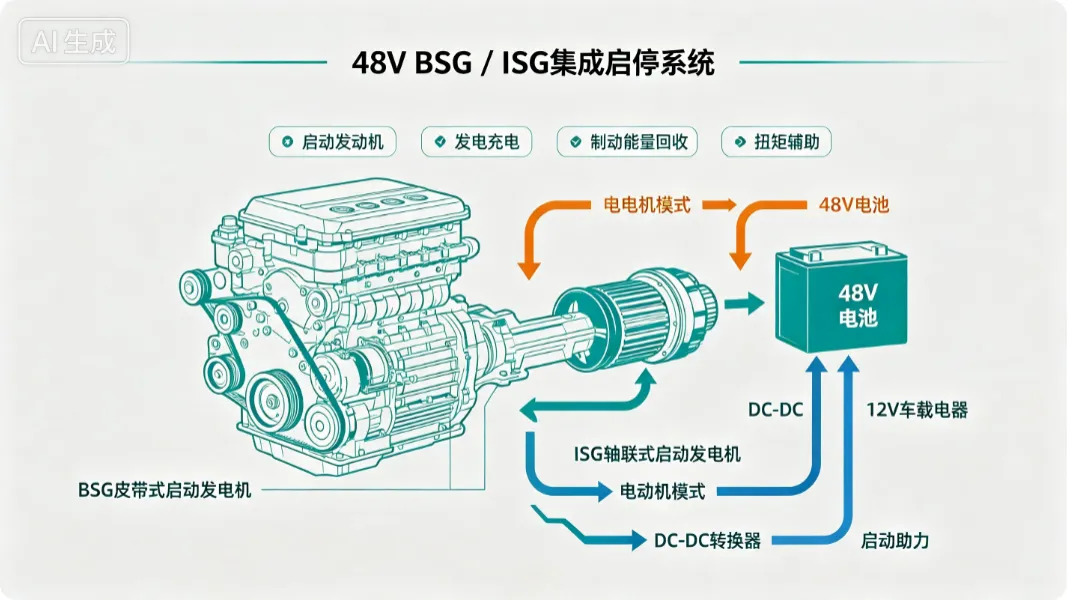
2、 48V mild hybrid integrated start stop system (BSG/ISG)
The 48V mild hybrid model eliminates the traditional independent starter and adoptsIntegrated starter generatorA motor has dual functions as a starter and generator, automatically switching working modes according to working conditions, providing a smoother and quieter start stop experience. It also has power assist functions and is mainly divided into two structures: BSG belt type and ISG shaft connected.
(1) Principle of BSG belt type integrated motor
The BSG motor is installed at the front end of the engine and connected to the crankshaft through a belt. Under start stop conditions, the motor switches toElectric motor modePowered by a 48V battery, the crankshaft is directly dragged through a belt to quickly start the engine without gear engagement, completely eliminating startup noise and shaking. When the vehicle is driving, coasting, or braking normally, the motor switches toGenerator modeThe crankshaft drives the rotation to generate electricity, which is rectified to charge the 48V battery. At the same time, it is reduced in voltage through a DC-DC converter to supply power to the 12V vehicle electrical system, efficiently recovering braking energy. In addition, when the vehicle accelerates rapidly, the motor can switch to motor mode again, outputting torque to assist the engine drive and reduce the overall fuel consumption of the vehicle.
(2) Principle of ISG shaft connected integrated motor
The ISG motor is installed between the engine and gearbox, directly rigidly connected to the crankshaft, and operates in the same mode as BSG. It can switch between motor and power generation conditions in both directions. Compared to belt driven BSG motors, ISG motors have more direct power transmission, faster response speed, smoother start stop, and better power assistance effects, but their structure is more complex and maintenance costs are higher.
(3) Common faults of BSG/ISG integrated motor
The core faults of BSG motor are concentrated in the transmission and electronic control system: the belt is prone to aging, elongation, and slipping under high loads for a long time. When combined with the failure of the tensioner, it will experience weak start stop, failed restart, and acceleration belt whistling, directly triggering the light hybrid system fault light and disabling the start stop function; The built-in power controller and power tube of the motor are prone to damage due to high temperature and high current, resulting in start stop failure, loss of energy recovery, and loss of power assist functions. Meanwhile, the wear of motor bearings can cause abnormal noise during operation, affecting the stability of the work.
Due to the special installation location of the ISG motor, the core fault is the damage of the electronic control module, resulting in the paralysis of the start stop and power generation functions; At the same time, bearing wear and seal oil leakage are prone to occur, and the infiltration of gearbox oil into the motor can cause short circuits, leading to serious malfunctions. Maintenance requires dismantling the gearbox, which is extremely costly.
3、 High frequency false fault of start stop system (non component damage)
In practical car use scenarios,More than 70% of start stop failure issues are not caused by damage to the starter or generatorBut it is a false fault caused by system protective disabling. The most common reason is that the AGM/EFB dedicated start stop battery is aging and running low, and when the voltage drops, the on-board computer will directly turn off the start stop function to protect the starting components and avoid starting failure. In addition, situations such as excessively high or low engine water temperature, high air conditioning load, insufficient brake vacuum, doors not tightly closed, and excessive external electrical equipment can trigger system protection and temporarily disable the start stop function. Replacing a regular non start stop battery or failing to match the battery level after the vehicle is powered on can also result in permanent start stop failure.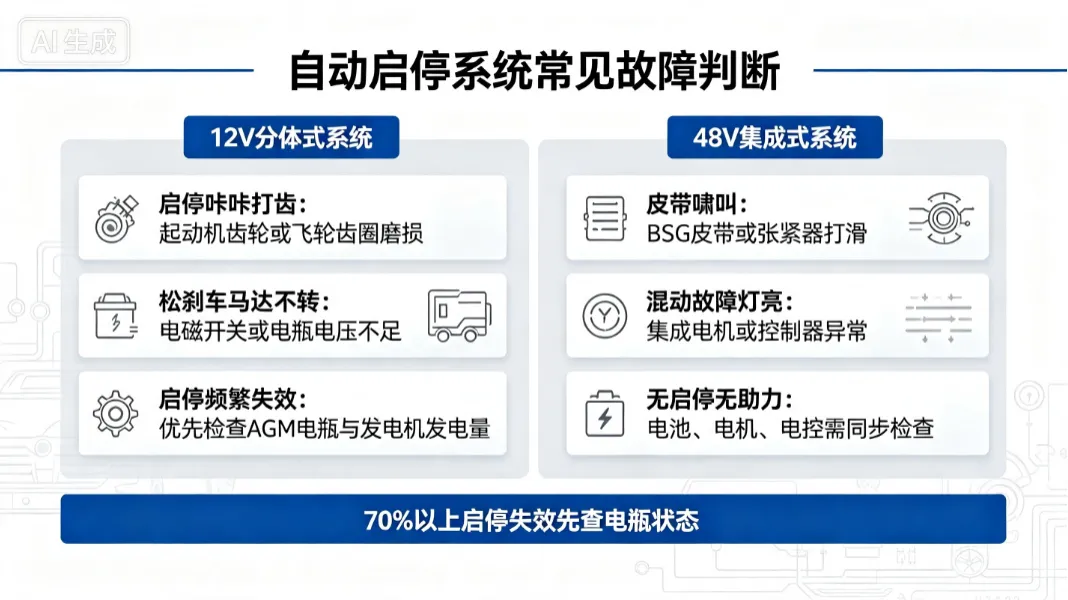
4、 Summary of the core differences between two types of start stop systems
The 12V split type system has a simple structure and low maintenance cost. There is abnormal gear meshing noise during start and stop. It relies on a reinforced starter to complete the start and an independent generator to complete power generation recovery, making it the mainstream solution for household fuel vehicles; The 48V integrated system does not have independent start stop components, and the motor works in both directions, with smooth start stop without shaking and extremely low noise. It also has power assist functions, but the components are precise and the maintenance cost is high, making it mostly used in light hybrid vehicles.
5、 Quick fault diagnosis skills
There is a rattling noise during start stop restart, mostly due to wear of the 12V starter gear and flywheel ring gear; There is no motor operation and only slight magnetic sound absorption when the brake is released, most likely due to a malfunction in the starter electromagnetic switch; The start stop function is gray and unavailable, but the vehicle can be ignited and driven normally without any abnormalities. Priority should be given to checking the battery status and generator power generation; The 48V model experiences start stop failure and accompanied by belt whistling, mostly due to BSG belt or tensioner faults; The instrument panel lights up the mild hybrid fault light, and there is no start stop or power assist, which is basically due to damage to the integrated motor or electronic control module.